
Right Reader. Right Lesson. Real growth.
Structured Literacy is an evidence-based, explicit, and systematic approach to teaching reading that is grounded in decades of cognitive neuroscience and literacy research. The framework organizes reading instruction around six foundational components — phonology, sound-symbol association, syllables, morphology, syntax, and semantics — building skills sequentially from simple to complex. Particularly vital for children with dyslexia but beneficial for all learners, Structured Literacy represents the most research-supported method for developing proficient readers, and parents and educators alike can advocate for and implement its principles.
Key Points
Reading is a constructed skill that must be explicitly and systematically taught, not naturally acquired through exposure alone.
Structured Literacy is defined by the International Dyslexia Association as instruction that is explicit, systematic, sequential, cumulative, diagnostic, and multisensory.
Phonological awareness — the ability to identify and manipulate sounds in spoken language — is one of the strongest predictors of reading success and must be taught before phonics instruction.
Sound-symbol association (phonics) must be taught explicitly in both directions: letter-to-sound and sound-to-letter, to build effective decoding skills.
Morphology instruction (prefixes, suffixes, roots) independently contributes to vocabulary growth and reading comprehension, especially as text complexity increases in later grades.
Syntactic awareness predicts reading comprehension beyond word-level decoding, making sentence-structure instruction an essential component of literacy development.
Children with dyslexia, characterized by phonological processing deficits, are highly responsive to Structured Literacy intervention when delivered with sufficient intensity and fidelity.
Parents can actively support reading development at home using tools like phoneme-grapheme mapping and decodable readers aligned with already-taught phonics patterns.
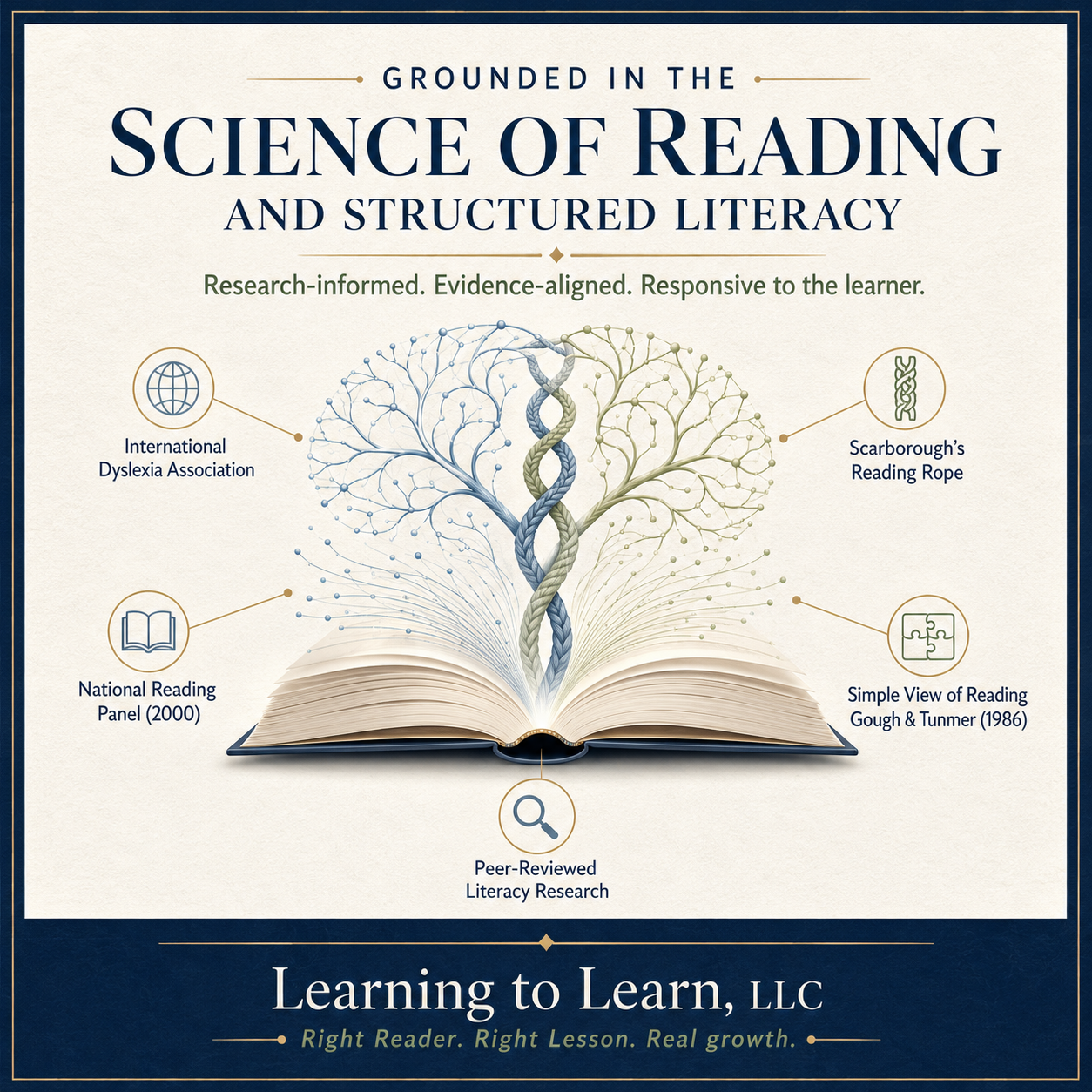
Grounded in the Science of Reading and Structured Literacy research. Sources include the International Dyslexia Association, the National Reading Panel (2000), Scarborough's Reading Rope, the Simple View of Reading (Gough & Tunmer, 1986), and peer-reviewed literacy research.
© Learning to Learn, LLC
Learn More | Start for FREE