From Reading Concerns to a Clear Plan
When your child is struggling to read, it can be difficult to know what to do next.
You may have received assessment reports, progress-monitoring data, intervention updates, or an IEP filled with unfamiliar language. You may have attended meetings and still left wondering:
- What is causing my child’s reading difficulty?
- Is the current intervention addressing the right skills?
- Is my child making enough progress?
- What should I ask at the next school meeting?
- Does the IEP clearly reflect what my child needs?
- How can I support my child without adding more frustration?
You do not have to navigate these questions alone.
At Learning to Learn, LLC, I help families understand what the paperwork, data, and reading behaviors are telling us so we can identify the learner’s needs and determine the most appropriate next steps.
We Translate Paperwork Into a Plan
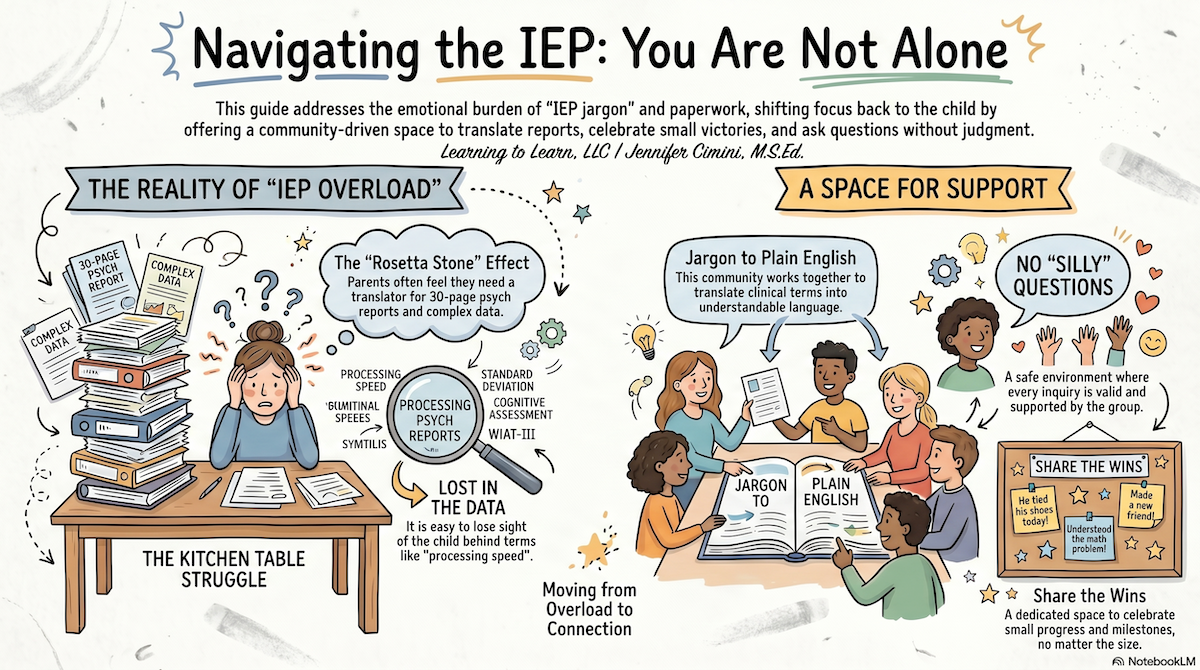
Evaluations, IEPs, screening reports, progress graphs, and classroom data can provide valuable information, but only when families understand what the information means.
My role is to help make that information clear and usable.
“We translate paperwork into a clear instructional plan—helping families understand where the reading breakdown is occurring, what their child needs to be taught next, and how progress should be measured.”
Together, we look beyond the general statement that a child is “below grade level” and begin asking more specific questions.
Is your child struggling to:
- Hear and manipulate the sounds in words?
- Connect sounds with letters?
- Read unfamiliar words accurately?
- Recognize spelling patterns automatically?
- Read smoothly and fluently?
- Understand vocabulary and language?
- Remember or apply previously taught skills?
- Comprehend increasingly complex text?
Understanding where the difficulty is occurring helps us move from worry and guesswork toward focused action.
Support With IEPs and School Meetings
An effective IEP should do more than describe a problem. It should clearly explain how the school will respond to your child’s needs.
I help families review whether the pieces of the IEP work together, including:
- Present levels of performance
- Reading and spelling data
- Measurable annual goals
- Specially designed instruction
- Intervention frequency and intensity
- Accommodations and supports
- Progress-monitoring procedures
- Plans for reviewing and adjusting instruction
You will receive guidance to help you better understand the documents, prepare meaningful questions, participate confidently in meetings, and advocate for decisions that are responsive to your child.
The goal is not conflict.
The goal is clarity, collaboration, and an instructional plan that makes sense for the learner.
Targeted Reading Intervention Guidance
More reading practice is not always the answer.
When a child is struggling, instruction must address the specific skill that is causing the breakdown. A student who cannot yet decode words accurately needs something different from a student who reads words fluently but struggles to understand language and meaning.
Effective intervention should be:
- Explicit
- Systematic
- Cumulative
- Evidence-based
- Matched to the child’s current skills
- Adjusted according to progress data
This is the foundation of the Right Reader, Right Lesson philosophy.
Instead of asking only, “What lesson is the class working on?” we ask:
What lesson does this reader need next?
Making Progress Visible
Progress should be understandable and visible to families.
Depending on the learner, meaningful growth may include:
- More accurate reading
- Fewer guesses
- Stronger spelling
- Improved recognition of taught patterns
- Greater fluency and automaticity
- Increased reading stamina
- Better comprehension
- More successful self-correction
- Increased confidence with unfamiliar words
- Greater independence during reading and writing
In some cases I have supported, students who began below grade-level expectations demonstrated steady, measurable growth within six months after targeted instruction, consistent progress monitoring, and close collaboration were established.
Every child’s needs and timeline are different. No specific result can be guaranteed. However, progress is more likely when instruction is carefully matched to the learner and adjusted when the data shows that a change is needed.
When the Current Plan Is Not Working
Progress monitoring should help answer one essential question:
Is this instruction working for my child?
When a student is not making sufficient progress, the answer should not be to continue the same plan indefinitely.
The team may need to reconsider:
- The instructional starting point
- The intervention method
- The size of the instructional group
- The frequency or duration of support
- The pace of instruction
- The amount of guided practice
- The type of corrective feedback
- The way progress is being measured
- Whether additional evaluation is needed
Assessment should be used as a compass for instruction—not simply as paperwork completed for compliance.
Close Communication and Collaborative Support
Children benefit when families, teachers, interventionists, and specialists share a clear understanding of the learner.
Close communication helps everyone understand:
- Which skills are being targeted
- What instruction is being provided
- What progress has been observed
- Which concerns remain
- What should happen next
I help families organize their concerns, interpret updates, prepare for conversations with the school, and keep the focus on the child’s instructional needs.
You deserve to leave meetings understanding what was discussed, what was decided, and how the team will know whether the plan is working.
This Service May Be Right for Your Family If:
- Your child is reading below grade level
- Your child has an IEP, 504 Plan, or intervention plan
- You are concerned about dyslexia or another reading difficulty
- You have received evaluation results but do not fully understand them
- Your child has participated in intervention without enough progress
- You are preparing for an IEP or school meeting
- You are unsure whether the current reading goals are appropriate
- You need help identifying informed questions to ask
- You want an independent review of your child’s literacy needs
- You want to better understand what effective reading instruction should include
What Support May Include
Depending on your family’s needs, services may include:
- Review of literacy evaluations and school documents
- IEP and goal review
- Reading-data interpretation
- Identification of possible skill gaps
- Intervention and instructional recommendations
- Preparation for parent-teacher, MTSS, eligibility, or IEP meetings
- Parent consultation and advocacy guidance
- Progress-monitoring review
- Questions and talking points for school-team discussions
- Recommendations for additional assessment or specialist support
- Ongoing communication and planning
Families Do Not Have to Figure It Out Alone
You know your child.
You notice the homework struggles, avoidance, guessing, forgotten skills, frustration, fatigue, and loss of confidence. Those observations are important.
You may not yet have the educational language to describe exactly what is happening—and you should not be expected to solve it alone.
My role is to help you understand the information, identify the questions that matter, and move forward with a plan grounded in evidence and responsive to your child.
Right Reader. Right Lesson. Real Growth.
Reading difficulty is not a reflection of your child’s intelligence, effort, or potential.
Many students need instruction that is more explicit, systematic, targeted, or intensive than what they have previously received.
With the right information and a focused plan, uncertainty can become direction.
Paperwork can become a roadmap.
Data can become a tool for better decisions.
And your child can receive instruction designed around the reader they are today and the progress they are capable of making tomorrow.
Jennifer Cimini, MS.Ed.
Learning to Learn, LLC
Literacy, Learning & Family Engagement Specialist | Independent Consultant
Know the reader. Find the need. Teach the right lesson next.
Schedule a Parent Consultation